Lençóis Maranhenses: when to go, where to stay and how to get there
Month-by-month lagoon levels from the park service, Barreirinhas vs Atins vs Santo Amaro, and the 2026 rule change for reaching Atins.
Lençóis Maranhenses: quando ir, onde ficar e como chegar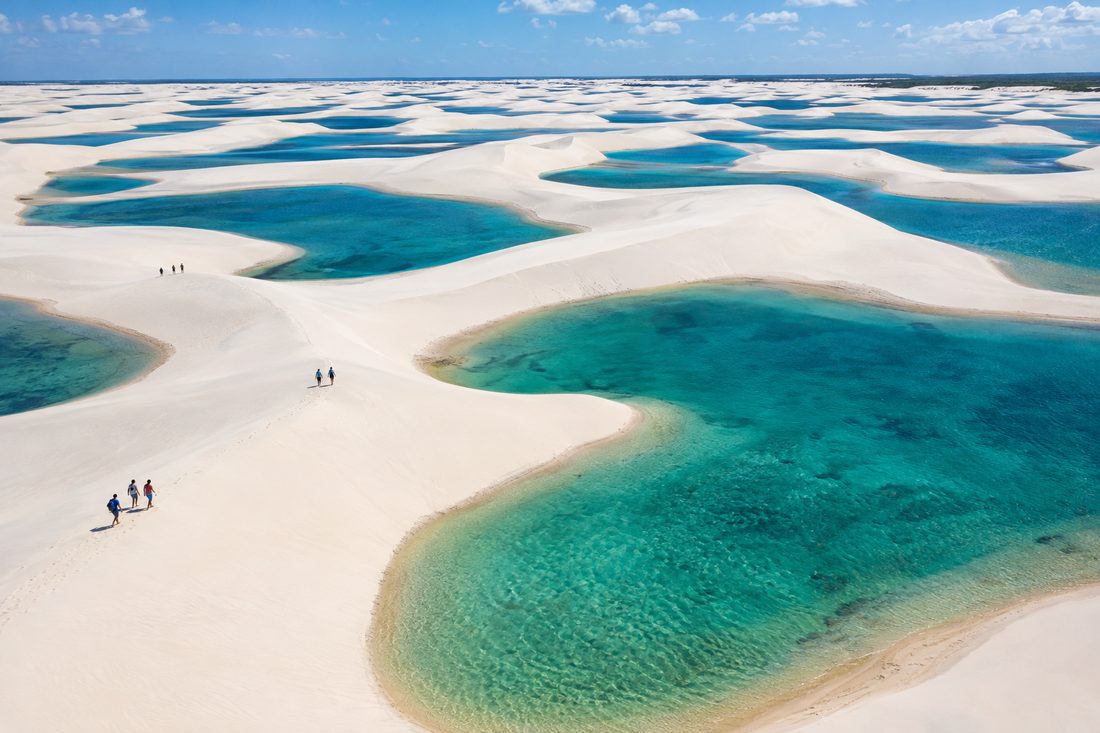
This guide contains affiliate links. If you buy through them, BrazilTube may earn a small commission at no extra cost to you. How we handle affiliate links.
Lençóis Maranhenses is one of the strangest landscapes on earth: white dunes that stretch to the horizon, with blue and green lagoons between them. Those lagoons are rainwater, not sea water, so they appear, swell and then disappear over the year. Arrive in the wrong month and you get a desert. This guide explains when to go, which town to use as a base and how to get there from São Luís.
When to go
The coast of Maranhão has two seasons. The park's official visitor guide, published by ICMBio, the agency that runs it, describes a rainy season from February to May and a dry season from June to January. The lagoons are fullest just after the rains and then dry out bit by bit, reaching their lowest point around November.
| Months | Lagoon level | What to expect |
|---|---|---|
| May to August | High | The postcard view. Full, colorful lagoons; swimming everywhere. |
| September to October | Medium, falling | Lagoons shrink and get shallower; swimming still possible but limited. |
| November to January | Low | Most temporary lagoons are dry. Swimming only in permanent ones. |
| February to April | Medium, rising | Heavy rain almost daily as the lagoons fill. |
Based on the ICMBio visitor guide, which names May to September as the best time to visit. The park adds that conditions depend on each year's rainfall, so check with the park or a local guide before you book.
The park is open every day from 8:00 to 18:00, according to ICMBio, and there is no entry fee, as Meridian notes. What you pay for is transport into the dunes.
Where to stay: three bases
Barreirinhas
Barreirinhas is the main town and the easiest base for a first visit. It has the most hotels, restaurants and tour operators, and the classic half-day trips to Lagoa Azul and Lagoa Bonita leave from here. The National Parks Atlas lists Barreirinhas as the gateway most visitors use. It is a river town rather than a dune town, so you ride a 4x4 for each trip into the park.
Atins
Atins is a small fishing village with sand streets where the Preguiças River meets the sea, at the park's northeastern edge. It is quieter and more beautiful than Barreirinhas, popular with kitesurfers, and short tours reach the dunes quickly. Meridian describes it as about an hour and a half by boat or two hours by 4x4 from Barreirinhas.
Santo Amaro do Maranhão
Santo Amaro, on the western side, sits right at the edge of the dunes. You can walk into the lagoons from town, which makes it the best choice if you want quiet and fewer tour groups. It is harder to reach and has fewer places to stay.
Our suggestion for a first trip of four or five nights: two nights in Barreirinhas for the classic lagoons, then two or three in Atins.
How to get there
Fly to São Luís, the state capital. From there:
- São Luís to Barreirinhas. The road is paved and about 240 to 260 km. Buses and minivans take around four hours, according to the National Parks Atlas. Frangipani Travel reports a scheduled bus ticket of around R$65 to R$75 one way in 2026.
- Barreirinhas to Atins. There is no paved road. Go by 4x4 shuttle on sand tracks or by boat down the Preguiças River. The boat trip often doubles as a tour, with stops at Vassouras, the Mandacaru lighthouse and Caburé.
You can't drive a rental car into the park. Only licensed 4x4 vehicles may enter, so you either join a tour or walk, which works well from Atins and Santo Amaro, as Frangipani Travel explains.
What to pack
There is no shade in the dunes and the sand reflects the sun, so sun protection matters more here than anywhere else in Brazil.
- Reef-safe sunscreen. You'll reapply after every swim: see reef-safe sunscreen on Amazon.
- A dry bag for your phone and camera on the 4x4 and boat rides: see dry bags.
- A wide-brim hat and sunglasses. The glare off the white sand is intense.
- Water, at least 1.5 liters per person. Tours stop at lagoons, not shops.
Lençóis pairs well with a few days on the Bahia coast. Our Salvador weekend guide is a good next stop.